

There’s no question that AI is changing the rules of interaction, trust, and brand design. It promises efficiency, automation, and entirely new product experiences that were previously out of reach without machine learning. But these advances come with challenges across building trust in products and systems that are inherently unpredictable.
For decades, digital products have been built on deterministic systems with predictable inputs and predictable outputs. But we are rapidly moving into a world of non-deterministic experiences that are intelligent and adaptive, which in turn is shaping the relationships we build with our users.
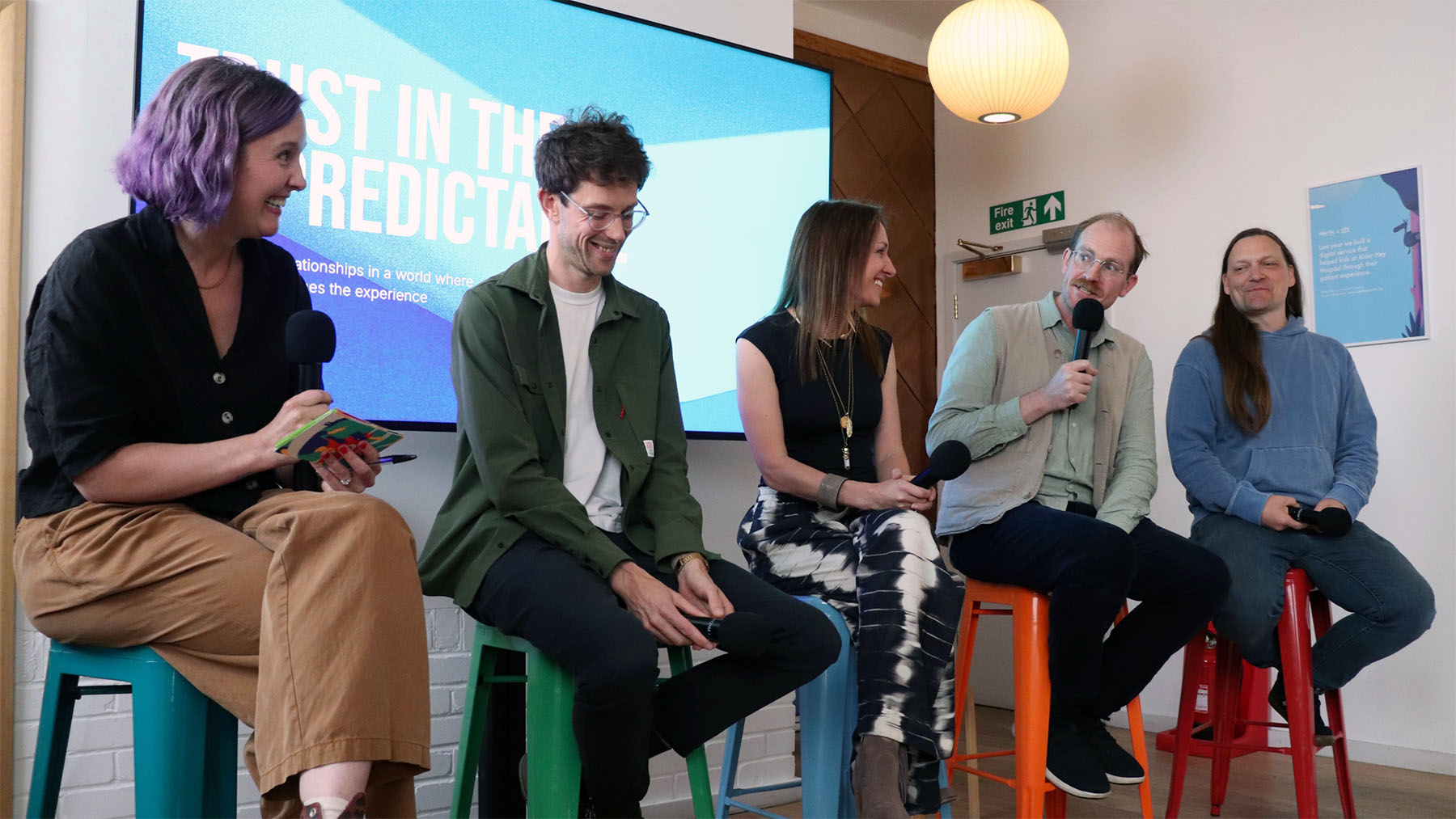
At our London Shoreditch studio, we brought together leaders from design, engineering, and marketing to explore how AI is changing the way we build products, and what it means for trust and human-centred design.
Panelists:
Josh Payton, VP of Design, Wise
Tessa Pettman, CMO, Seapoint
Taylor Westoby, Design Principal, ustwo
Alasdair Blackwell, Engineering Principal, ustwo
Moderator: Claire Grinton, Head of Growth and Marketing, ustwo
Key takeaways:
1) Strong foundations and operations make for defensible output
In the era of AI product development, strong design systems are all the more critical. AI amplifies both organisational strengths and weaknesses. It exposes fragmentation, inconsistency, and ambiguity within a design system when delivered at scale. While poor documentation and unclear ownership create challenges in any organisation, those challenges run the risk of being far more significant when AI agents are acting on behalf of designers and engineers.
In this environment, every component must be designed for shared understanding, discoverability, and consistent application. Design systems must also be structured around the data models, APIs, and orchestration logic that underpin digital experiences, enabling both humans and AI systems to work from the same source of truth.
2) Transparency breeds trust
And despite all our talk about the supremacy of this model or that, what must be communicated to end users is not certainty, but confidence.
This could look like sharing AI-led decision making logic, assigning a confidence score to AI-generated outcomes, or simply explaining why and how a generative experience has been created. These disclosures offer context for the user and clear ways for them to assess or intervene to get the best outcome for their needs.
3) Trust begins within our own organisations
Trust doesn't begin and end with users either. It starts inside the organisation itself. Teams need a shared understanding of the problem they are solving, alignment on where AI can add value, and clarity on how it will be used to deliver outputs responsibly.
“Human-in-the-loop” has become such a familiar phrase that it risks being reduced to a buzzword. In many organisations, it amounts to little more than a final QA step for AI-generated code or content. But our panel argued that meaningful human involvement needs to happen much earlier and throughout the process.
Human ingenuity remains essential in defining the problem, creating and maintaining high-quality data, establishing editorial standards, setting governance and guardrails, and designing the evaluation frameworks that keep development on track. Creating the right conditions for AI to succeed is just as important as creating the right conditions for people, and those conditions, and the rationale behind them, must be documented clearly to ensure success.
The panel returned repeatedly to the importance of transparency. Making AI use visible, providing support and oversight during reviews, creating safe spaces for experimentation, and setting the expectation that any output, whether produced by a human or an AI, can be explained and defended by its owner all help to build confidence internally. Trustworthy experiences are ultimately rooted in trustworthy ways of working.
4) Brand is more important than ever
When anyone can make an app or a digital product, what makes someone choose yours? What invites someone to invest more deeply in those experiences? And importantly, what keeps them coming back?
Especially in highly-regulated industries like healthcare and financial services, those choices are informed in great part by the trust built in the brand outside of the direct product experience, and the proliferation of next entrants to the market make that all the more critical. It’s not enough to make the product anymore – you have to make it meaningful to users. That means investing in how you show up and consistently delivering on your promises with commitment.
Final thoughts
As AI makes product experiences more adaptive, generative, and unpredictable, trust can no longer be expected as an outcome of good design. It has to be central to the foundations, the systems, standards, data, governance, and decision-making processes that shape how products are built.
That means combining human judgement with machine capability in deliberate, visible ways. It means designing systems people can interrogate and improve. It means building products that earn trust through transparency. To do that, we need to keep people at the centre of decision-making: the teams creating these systems, the organisations responsible for them, and the users whose trust we are asking to earn.
For the full conversation, watch the video above or head to ustwo’s YouTube channel.
Interested in seeing how we can help transform your digital product, service, or experience? Let's chat.